EDDM Postcard Sizes & Requirements: 2026 USPS Compliance Guide
Every Door Direct Mail (EDDM) lets you send postcards, flyers, and menus to every address on a postal carrier route - no mailing list required. But USPS enforces strict EDDM requirements for size, weight, and thickness that determine whether your mail piece qualifies for the discounted EDDM postage rate. Get any of these EDDM requirements wrong, and your entire mailing gets rejected at the post office counter.
This guide covers every EDDM requirement you need to know in 2026: minimum and maximum postcard dimensions, thickness limits, weight caps, indicia placement, and the most popular EDDM postcard sizes that balance print cost with mailbox impact. We've processed millions of EDDM pieces at Mail Processing Associates and have seen every EDDM compliance mistake in the book - so you don't have to make them.
Need help with your EDDM campaign? Get a free quote from MPA - we handle design, printing, and postal drop-off from our Lakeland, FL facility.
EDDM Size Requirements: The Official USPS Rules
USPS classifies EDDM mail pieces as "flats" - not letter-size mail. That classification is central to understanding EDDM requirements, because it sets specific minimum dimensions your postcard must exceed to qualify.
Minimum Dimensions
Your EDDM mail piece must meet at least one of these conditions:
- Height greater than 6.125 inches, OR
- Length greater than 11.5 inches, OR
- Thickness greater than 0.25 inches
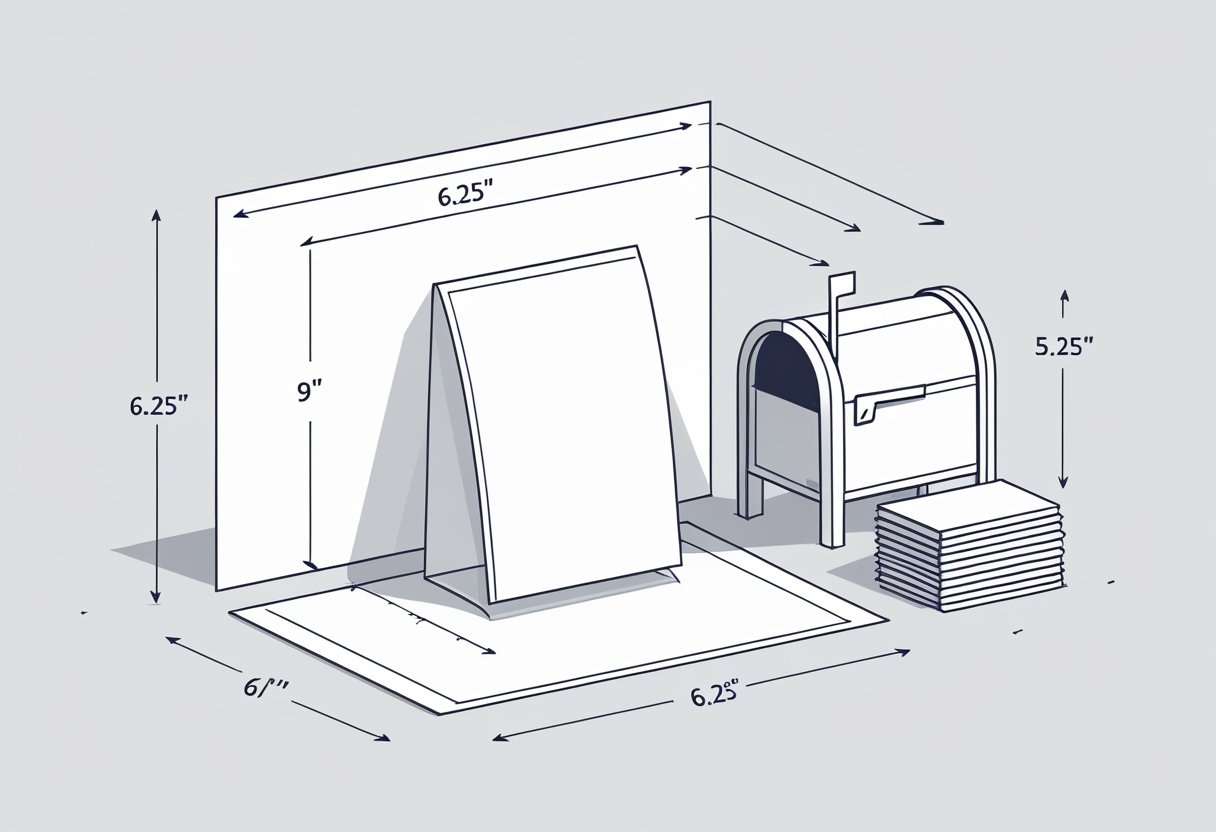
Most EDDM postcards satisfy the requirement by exceeding both the height and length minimums. A 6.25 x 9 inch postcard, for example, clears the 6.125-inch height minimum.
Maximum Dimensions
- Maximum height: 12 inches
- Maximum length: 15 inches
Anything larger than 12 x 15 inches won't qualify for EDDM and will be returned or charged at a higher rate.
Thickness Requirements
- Minimum thickness: 0.007 inches (roughly equivalent to standard 14pt cardstock)
- Maximum thickness: 0.75 inches
Standard postcard stock (14pt or 16pt coated cardstock) easily meets the minimum thickness requirement. If you're mailing a folded piece, booklet, or menu, check the folded thickness against the 0.75-inch maximum.
Weight Limit
Among the most overlooked EDDM requirements is the weight cap. Each EDDM piece must weigh 3.3 ounces or less. Standard postcards on 14pt or 16pt stock fall well under this limit. Heavier stocks (like 24pt or laminated pieces) or larger formats (9 x 12 or bigger) should be weighed before printing a full run.
Shape Requirement
EDDM mail pieces must be rectangular. No die-cut shapes, rounded postcards, or irregular formats qualify for EDDM rates.
Most Popular EDDM Postcard Sizes
Meeting EDDM requirements is the baseline - not all sizes that technically qualify make practical sense. Print costs, mailbox fit, design space, and postal handling all factor into which size delivers the best return. Here are the four most commonly used EDDM postcard sizes, ranked by popularity.
6.25 x 9 Inches - The Go-To EDDM Size
This is the most popular EDDM postcard size for good reason. It meets USPS minimum requirements (6.25 inches exceeds the 6.125-inch height minimum), fits comfortably in standard mailboxes, and costs less to print than larger formats.
Best for: Restaurants, salons, dental offices, home services, and retail stores running local promotions. The 6.25 x 9 format gives you enough space for a headline, offer, map, and call to action without overwhelming the recipient.
Printing cost: Typically $0.08-$0.15 per piece in quantities of 5,000+ on 14pt coated stock.
6.25 x 11 Inches - Extended Format
The 6.25 x 11 format gives you extra length for menus, service lists, coupon strips, and detailed offers without jumping to a full letter-size piece. The 11-inch length creates a landscape layout that works well for side-by-side comparisons, multi-service layouts, and designs with more content than a standard postcard can handle.
Best for: Restaurants (condensed menu on one side), home service companies with multiple offerings, coupon mailers, and businesses that need more space than 6.25 x 9 but want to keep costs below 8.5 x 11.
Printing cost: Around $0.10-$0.18 per piece at 5,000+.
8.5 x 11 Inches - Letter-Size Impact
An 8.5 x 11 postcard commands attention. It's the same size as a sheet of paper, which makes it impossible to overlook in a stack of mail. The extra space works well for menus, event calendars, or detailed service listings.
Best for: Restaurants (full menu on one side), real estate agents (property listings), and businesses with multiple offers or services to highlight.
Printing cost: Roughly $0.12-$0.22 per piece at 5,000+ quantity.
9 x 12 Inches - Maximum Visibility
At 9 x 12 inches, you're mailing something that can't be missed. This is the largest commonly used EDDM format and gives you the most design real estate. It's also the heaviest to print and the most expensive to produce.
Best for: Grand openings, major promotions, and high-stakes campaigns where standing out matters more than per-piece cost. Political campaigns and real estate agents also use this size for maximum neighborhood impact.
Printing cost: Approximately $0.15-$0.28 per piece at 5,000+.
EDDM Size Comparison Table
| Size | Dimensions | Meets USPS Min? | Print Cost (5K+) | Best Use Case |
|---|---|---|---|---|
| 6.25 x 9 | 6.25" H x 9" L | Yes (height) | $0.08-$0.15/pc | Most common - local promos |
| 6.25 x 11 | 6.25" H x 11" L | Yes (height) | $0.10-$0.18/pc | Menus, detailed offers, coupons |
| 8.5 x 11 | 8.5" H x 11" L | Yes (both) | $0.12-$0.22/pc | Maximum design space, letter-size impact |
| 9 x 12 | 9" H x 12" L | Yes (both) | $0.15-$0.28/pc | Grand openings, political |
Sizes That Do NOT Qualify for EDDM
This is where EDDM requirements trip up more first-time mailers than any other rule. Standard postcard sizes like 4 x 6 and 5 x 7 do not qualify for EDDM because they fall below the minimum height requirement of 6.125 inches.
If you already have a 4 x 6 or 5 x 7 postcard design, you have two options:
- Resize the design to at least 6.25 x 9 inches for EDDM eligibility
- Mail at standard postcard rates using a targeted mailing list instead of EDDM - learn about postcard mailing costs
Other formats that don't qualify: square postcards, postcards smaller than 6.125 inches on the short side, and any non-rectangular shape.
EDDM Postage Rates in 2026
One of EDDM's biggest advantages is the low per-piece postage rate compared to First-Class or standard Marketing Mail:
| Mail Class | Per-Piece Rate | Mailing List Required? |
|---|---|---|
| EDDM Retail | $0.247 | No |
| EDDM BMEU | $0.242 | No |
| Marketing Mail Letter | $0.430+ | Yes |
| First-Class Postcard | $0.560 | Yes |
EDDM Retail is the self-service option - you drop off bundled postcards at your local post office. EDDM BMEU (Business Mail Entry Unit) requires a mailing permit and is typically handled by a mail service provider like MPA.
The rate difference is small ($0.005/piece), but on a 10,000-piece mailing, that's $50 saved. More importantly, BMEU entry means a professional handles bundling, facing, and postal paperwork. That reduces the chance of rejection for not meeting EDDM requirements at the acceptance window.
Want us to handle the postal side? MPA's EDDM services include route selection, printing, and BMEU drop-off. Use our free EDDM route planner to see how many homes you can reach in your area.
Common EDDM Requirements Mistakes That Get Mailings Rejected
After handling thousands of EDDM campaigns, these are the mistakes we see most often - and each one results in your mailing being rejected at the post office window or charged at full postage rates.
Mistake 1: Designing at 6 x 9 Instead of 6.25 x 9
A 6 x 9 postcard does not meet EDDM requirements. The height (6 inches) falls below the 6.125-inch minimum. This is the most common EDDM rejection we see - designers round down to a "clean" 6 x 9 and the mailing fails. Always design at 6.25 x 9 or larger to give yourself clearance.
Mistake 2: Measuring Bleed Size Instead of Trim Size
USPS measures the finished, trimmed postcard - not the print-ready file with bleed. If your design file is 6.625 x 9.25 inches (with 0.125" bleed on each side), the trimmed piece is 6.375 x 9 inches. That meets EDDM requirements. But if your design file is 6.375 x 9.25 and you assumed that was the final size, the trimmed piece is only 6.125 x 9 - right at the minimum, not above it. Design your trim size first, then add bleed.
Mistake 3: Forgetting the Indicia
EDDM pieces require specific EDDM indicia in the upper right corner - not a stamp, not a metered impression, and not a standard bulk mail permit imprint. Showing up at the post office with 5,000 postcards and no EDDM indicia means starting over.
Mistake 4: Wrong Piece Count Per Route
EDDM Retail requires that you mail to every active delivery address on a selected route (minimum 200 pieces). You can't cherry-pick 50 addresses from a route. If a route has 400 active deliveries, you print 400 pieces for that route. Failing to match piece counts to route counts violates EDDM requirements and results in rejection.
Mistake 5: Paper Too Thin
Standard 80 lb gloss text stock (commonly used for flyers) does not meet the 0.007-inch minimum thickness requirement for EDDM. Use 14pt cardstock or heavier. If you're unsure about your paper thickness, ask your printer for a caliper measurement before running the full job.
EDDM Indicia and Address Requirements
Beyond size, weight, and thickness, EDDM requirements include specific markings on every mail piece to qualify for the discounted postage rate.
Indicia Placement
The EDDM Retail indicia must appear in the upper right corner of the address side. This replaces a stamp or postage meter impression. The indicia text reads:
EDDM Retail
U.S. Postage Paid
[City, State, ZIP]
If you're mailing through a BMEU with a permit, the indicia format is slightly different and includes your permit number.
Recipient Line
Instead of a name and address, EDDM pieces display one of these approved lines in the address block area:
- "Postal Customer"
- "Residential Customer"
- "Local Postal Customer"
No individual names, no street addresses. That's the whole point of EDDM - you're mailing to every door on a route, not to a specific list of people.
Address Block Clear Zone
USPS requires a clear zone on the address side for postal processing. This area - roughly the bottom-right quarter of the address side - should be kept free of heavy graphics, dark backgrounds, or text that could interfere with postal sorting equipment.
How to Choose the Right EDDM Postcard Size
Picking between a 6.25 x 9 and a 9 x 12 comes down to three factors:
1. Budget Per Piece
Your total per-piece cost includes printing, postage, and design. Postage is the same regardless of size ($0.247 for EDDM Retail), so the variable cost is printing. A 6.25 x 9 postcard at $0.10/piece + $0.247 postage = $0.347 total. A 9 x 12 at $0.22/piece + $0.247 = $0.467 total. On 5,000 pieces, that's a $600 difference.
2. Message Complexity
If your offer is simple - "20% off this month" with a phone number - a 6.25 x 9 is plenty of space. If you're printing a restaurant menu, a list of 10 services with prices, or a detailed property listing, go bigger.
3. Competitive Mailbox Environment
If your competitors are already mailing EDDM in your area, a larger format helps you stand out. An 8.5 x 11 or 9 x 12 postcard physically dominates a mailbox full of 6.25 x 9 pieces.
EDDM Mailing Quantity Rules
Beyond size requirements, USPS also sets quantity limits for EDDM:
- Minimum per route: 200 pieces (or every address on the route, whichever is fewer)
- Maximum per route per day: 5,000 pieces
- Maximum per ZIP code per day: 5,000 pieces (EDDM Retail)
You can mail to multiple routes in a single drop-off, and you can mail on consecutive days to cover larger areas. MPA's EDDM planner tool helps you select routes by ZIP code and see household counts before committing to a print quantity.
Design Tips for EDDM Compliance
Meeting EDDM size requirements is step one. These design details help you satisfy the full set of EDDM requirements and prevent rejection at the post office counter:
- Bleed: Add 0.125 inches of bleed on all sides. Your finished trimmed size should meet EDDM minimums, not the bleed size.
- Safe zone: Keep critical text and images at least 0.25 inches from the trim edge.
- Address panel: Reserve the bottom-right area of the address side (roughly 4 x 2 inches) for the indicia, "Postal Customer" text, and postal barcode area. Don't place key messaging here.
- Paper orientation: Postcards can be landscape or portrait orientation - USPS doesn't restrict this. The height and length requirements refer to the short and long sides, respectively.
- Coatings: UV coating, aqueous coating, and matte/gloss lamination are all EDDM-compatible as long as the finished thickness stays under 0.75 inches.
For step-by-step layout guidance, see our EDDM postcard design tips and how to design a postcard for EDDM.
EDDM vs. Targeted Direct Mail: When to Use Each
EDDM isn't always the right choice. Here's when targeted direct mail makes more sense:
| Factor | EDDM | Targeted Direct Mail |
|---|---|---|
| Mailing list | Not needed | Required |
| Targeting | By carrier route (geography) | By name, demographics, purchase history |
| Postage rate | $0.247/piece | $0.430+/piece (Marketing Mail) |
| Personalization | None - same piece to every door | Variable data (name, offer, images) |
| Best for | Local businesses, saturation coverage | Specific audiences, personalized offers |
| Minimum quantity | 200 per route | No USPS minimum |
If your business serves a specific radius - a restaurant, dental office, or home services company - EDDM's low cost per piece and no-list-required simplicity is hard to beat. If you need to reach specific people (past customers, certain demographics, high-income households), targeted direct mail with a purchased or house mailing list delivers better results per piece.
Not sure which approach fits your campaign? Schedule a free consultation with MPA and we'll help you decide based on your audience, budget, and goals.
The EDDM Process: From Design to Mailbox
Understanding EDDM requirements is the first step. Here's how a complete EDDM campaign flows from concept to delivery:
- Select your routes: Use the USPS EDDM tool to choose carrier routes by ZIP code. Filter by residential count, median income, or household size.
- Design your postcard: Pick a size that meets EDDM requirements (6.25 x 9 minimum recommended). Include the EDDM indicia, "Postal Customer" text, and keep the address panel clear.
- Print: Use 14pt or 16pt coated cardstock. MPA prints on Xerox Iridesse and Versant production presses for color accuracy and consistency across large runs.
- Bundle and face: Postcards must be bundled by carrier route, all facing the same direction, with a facing slip on top of each bundle identifying the route number.
- Drop off or enter at BMEU: For EDDM Retail, bring bundled postcards to your local post office with a completed PS Form 3587. For BMEU entry, your mail service provider handles the documentation and drop-off.
- Delivery: USPS delivers your postcards within 3-14 business days of acceptance, depending on route volume and local processing capacity.
Working with a full-service provider like MPA means steps 2 through 5 are handled for you. You approve the design and select the routes - we print, bundle, and enter the mailing. Learn more about our EDDM mailing services or get an EDDM quote.
Frequently Asked Questions
What is the minimum size for an EDDM postcard?
The minimum size for EDDM is a mail piece that exceeds 6.125 inches in height OR 11.5 inches in length OR 0.25 inches in thickness. Most EDDM postcards start at 6.25 x 9 inches or 6.25 x 11 inches to comfortably clear the height minimum.
What is the largest postcard size for EDDM?
The maximum EDDM mail piece size is 12 x 15 inches. However, the largest commonly used size is 9 x 12 inches. Anything beyond that gets expensive to print, hard to handle, and doesn't fit well in residential mailboxes.
Can I send a 5x7 postcard through EDDM?
No. A 5 x 7 postcard does not meet EDDM minimum size requirements because both dimensions fall below the 6.125-inch height and 11.5-inch length thresholds. You would need to mail a 5 x 7 at standard First-Class postcard rates ($0.56 each) with a targeted mailing list.
How much does EDDM postage cost in 2026?
EDDM Retail postage is $0.247 per piece in 2026. EDDM BMEU (through a mail service provider with a permit) is $0.242 per piece. Both rates apply regardless of postcard size, as long as the piece meets all EDDM requirements.
What paper weight should I use for EDDM postcards?
14pt coated cardstock is the industry standard for EDDM postcards. It meets the 0.007-inch minimum thickness requirement, feels substantial in hand, and keeps printing costs reasonable. 16pt stock is also popular for a more premium feel. Anything thinner than 12pt risks feeling flimsy and may not meet the thickness minimum.
Do I need a mailing list for EDDM?
No. That's EDDM's primary advantage - you select carrier routes by ZIP code instead of purchasing a mailing list. Every residential address on the selected routes receives your piece. This eliminates list costs and simplifies campaign setup.
How many pieces do I need to send for EDDM?
You must mail a minimum of 200 pieces per carrier route (or every address on the route if fewer than 200 addresses exist). The maximum is 5,000 pieces per ZIP code per day for EDDM Retail. There's no overall campaign minimum beyond the per-route requirement.
What goes in the address area of an EDDM postcard?
Instead of a recipient name and address, print "Postal Customer" or "Residential Customer" in the address block. The EDDM Retail indicia (postage mark) goes in the upper right corner of the address side. No individual names or street addresses are used.